 Sign In






Where People Get Answers Today: Google Still Leads, AI at 36%
Info
-
Source: NP Digital
-
Date: April 2026
-
Category: AI & GEO Optimization
-
Study Methodology: Data from surveying 2,000 people in 16 countries. Self-reported primary answer-seeking channel across five categories.
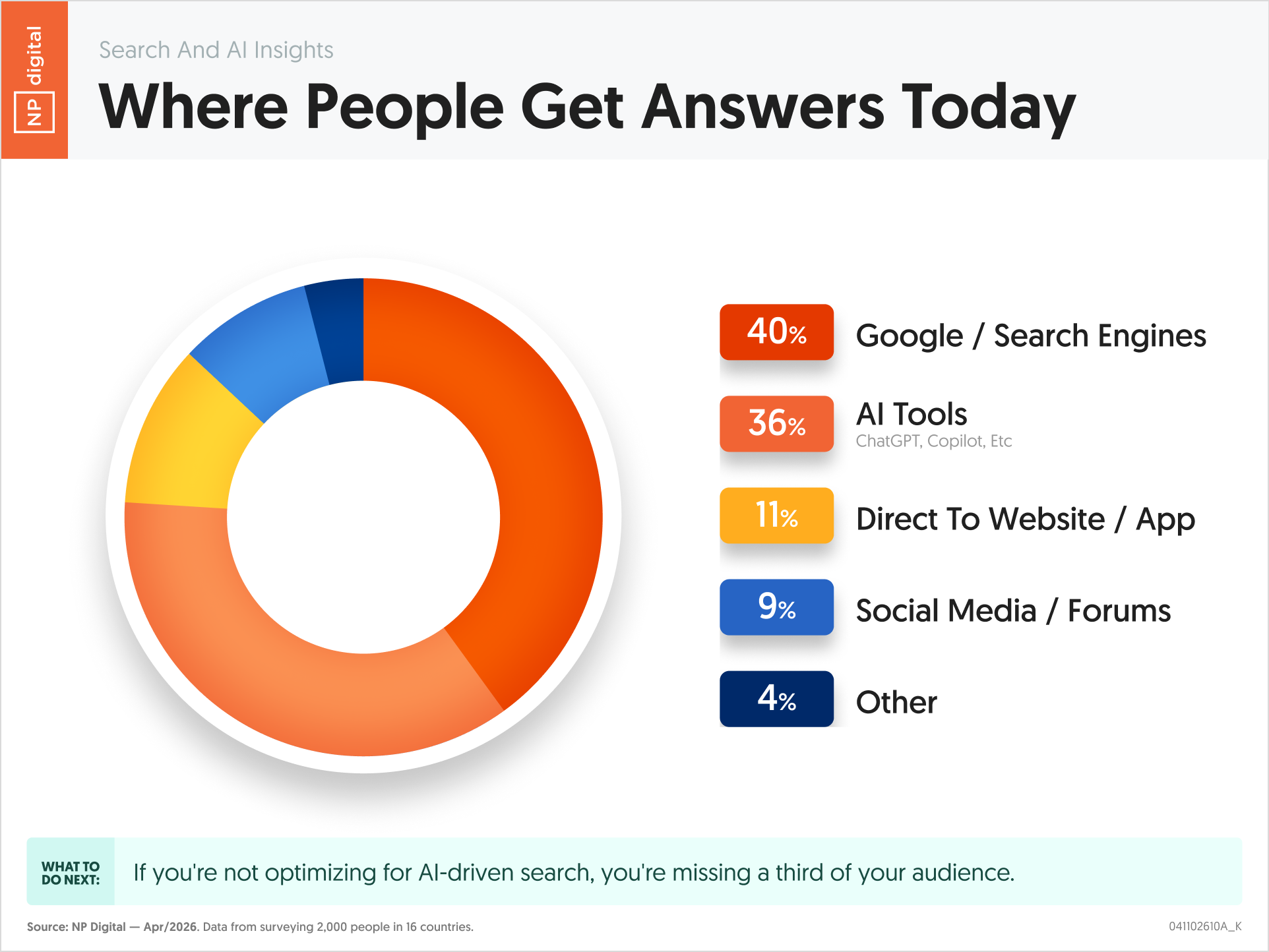
Search behavior has split. For the first time, a substantial share of the global population is bypassing traditional search engines and going directly to AI tools for answers. This survey of 2,000 people across 16 countries finds that AI tools already account for 36 percent of answer-seeking behavior, just 4 percentage points behind Google and traditional search engines. For any brand that depends on search visibility, that gap is the most important number in current digital marketing strategy.
Essential Statistics
- Google and search engines account for 40 percent of where people go to get answers, the largest single channel in the dataset.
- AI tools including ChatGPT, Copilot, and similar platforms account for 36 percent of answer-seeking behavior, the second largest channel.
- Direct website or app access accounts for 11 percent of answer-seeking behavior.
- Social media and forums account for 9 percent of answer-seeking.
- Other sources account for the remaining 4 percent.
- The combined AI tools share of 36 percent across a 2,000-person, 16-country sample makes this one of the largest and most geographically diverse datasets confirming AI search behavior at scale.
Key Takeaways
- A 4 percentage point gap between Google at 40 percent and AI tools at 36 percent is not a forecast. It is the current reality across a global sample of 2,000 people. Brands that are not yet treating AI search visibility as a primary channel are already missing more than a third of answer-seeking behavior.
- The 36 percent AI tool share across 16 countries confirms that AI search adoption is not a US-centric or tech-enthusiast phenomenon. It is a global behavioral shift that is already affecting how people find businesses, products, and information across virtually every market.
- Direct website and app access at 11 percent combined with social media and forums at 9 percent confirms that branded destination visits and social discovery remain meaningful channels, but neither individually or combined approaches the scale of either Google or AI tools.
- The proximity of AI tools to Google in answer-seeking share suggests the gap will continue to close. If current adoption trends hold, AI tools may reach parity with or surpass traditional search engines within a relatively short additional time horizon.
- Brands that invest in both traditional SEO and GEO simultaneously are the ones best positioned for the current split environment. Optimizing for only one channel is now optimizing for only 40 percent or 36 percent of answer-seeking behavior, not the full available audience.
Actionable Insights
- Treat GEO as a required channel, not an experimental one. Brands without a GEO strategy are currently invisible to more than a third of answer-seeking behavior in their markets. Set a GEO budget and implementation timeline before the next planning cycle.
- Frame a combined search investment strategy internally. The data makes the case for running SEO and GEO in parallel rather than choosing between them. Neither channel alone reaches the full answer-seeking audience. Present the two figures together when making the budget case for maintaining or increasing search investment across both disciplines.
- Audit which of your highest-priority informational queries are already generating AI-generated responses by testing them in ChatGPT, Gemini, and Perplexity. For queries where your brand does not appear in AI responses, you are invisible to the 36 percent of the audience using AI tools for those questions. That audit defines your current GEO gap before any optimization work begins.
- Build AI-optimized content for your top ten answer-seeking queries in your category. Structured, factual, well-sourced content that directly answers common questions is the content type most likely to earn AI citations. Publishing ten high-quality GEO-optimized pieces targeting your most important answer queries will produce measurable citation gains faster than a broad unfocused content calendar.
- Measure your brand’s share of voice in AI responses quarterly alongside your organic search ranking reports. At 36 percent AI tool usage, AI share of voice is now a primary performance metric rather than a secondary one. Add AI citation monitoring to your standard reporting stack so that movement in AI visibility is tracked with the same rigor as keyword ranking and organic traffic.
“Thirty-six percent of people are now getting their answers from AI tools. Google is at 40 percent. That is a four-point gap across 2,000 people in 16 countries. If your search strategy is still 100 percent focused on Google, you are optimizing for 40 percent of the answer-seeking audience and ignoring 36 percent of it. That math does not work for much longer.” – Neil Patel