 Sign In





 Ubersuggest
  AnswerThePublic
 What Drives AI Citation Authority? 200 Marketers Weigh In
Info
-
Source: NP Digital
-
Date: April 2026
-
Category: AI & GEO Optimization
-
Study Methodology: Data from surveying 200 marketers. Self-reported ranking of factors contributing to brand authority growth for AI citation purposes.
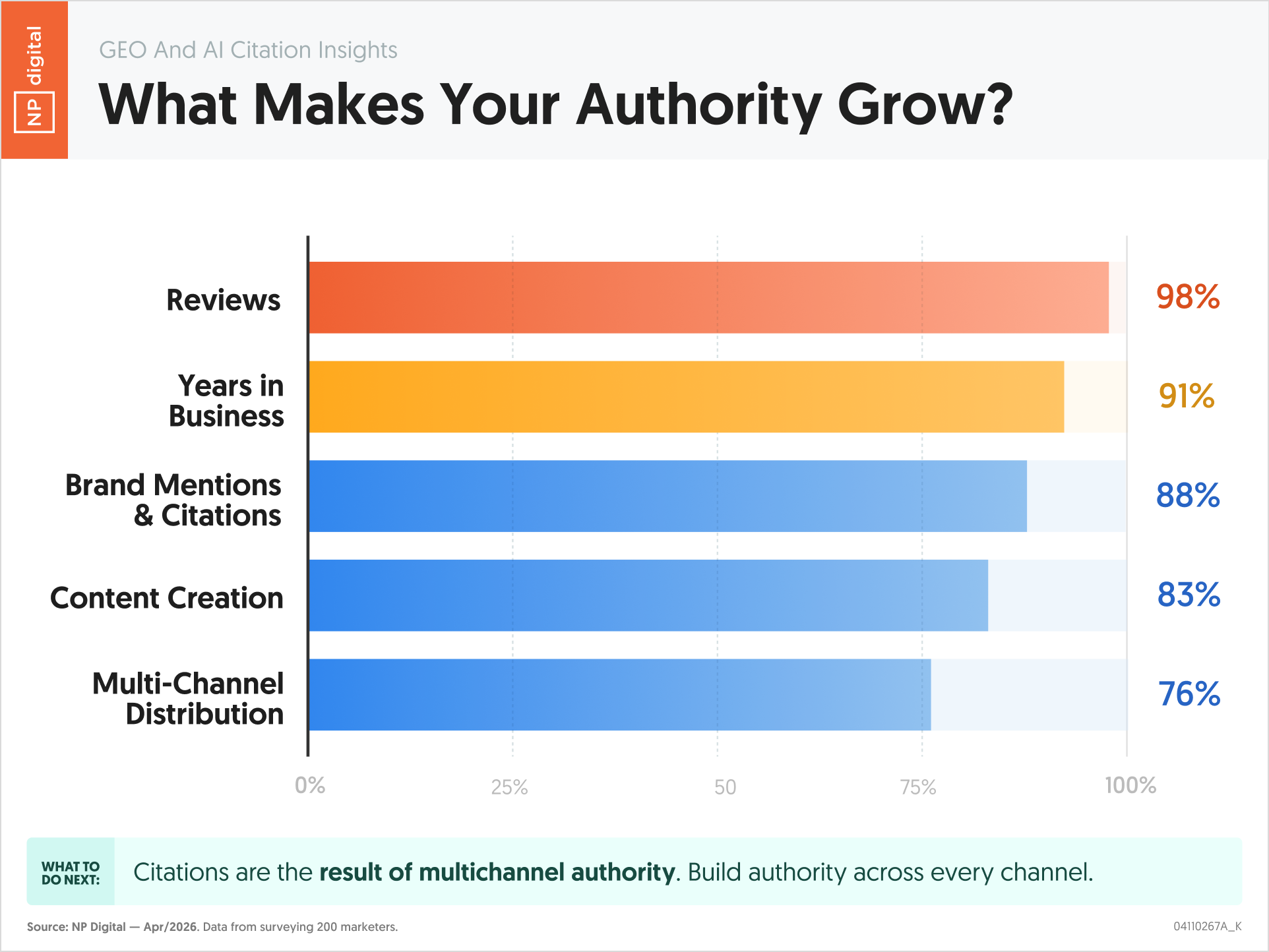
AI citation authority does not come from a single tactic. This survey of 200 marketers identifies the signals that most consistently drive brand authority growth in the context of generative engine optimization, and the results show a clear hierarchy. Understanding which signals carry the most weight helps brands sequence their GEO investment rather than trying to build all authority signals simultaneously.
Essential Statistics
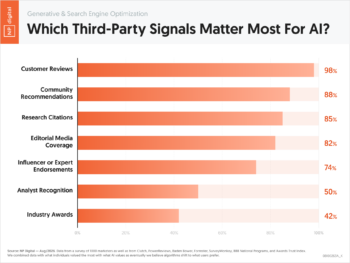
- Reviews were identified by 98 percent of marketers as a primary authority growth driver, the highest-ranked signal in the dataset.
- Years in business ranked second at 91 percent, reflecting how longevity signals credibility to both AI systems and the human evaluators who inform their training.
- Brand mentions and citations ranked third at 88 percent, confirming that external reference volume matters significantly for AI citation authority.
- Content creation ranked fourth at 83 percent, meaning the majority of marketers see consistent content output as a foundational authority signal.
- Multi-channel distribution ranked fifth at 76 percent, still endorsed by more than three in four marketers surveyed.
- All five factors received endorsement from more than 75 percent of respondents, indicating that authority growth is genuinely multi-factor rather than concentrated in any single signal.
Key Takeaways
- Reviews at 98 percent consensus reflect a finding that appears repeatedly across GEO and AI citation research: third-party validation through reviews is one of the most accessible and highest-signal authority inputs for AI systems. AI models weigh external social proof heavily when assessing whether a brand is trustworthy enough to cite.
- Years in business at 91 percent is not directly controllable but has strategic implications. Brands with longer operating histories have a structural authority advantage with AI systems that newer brands need to offset through higher performance on the other four signals.
- Brand mentions and citations at 88 percent points to the value of digital PR, media coverage, and platform presence as authority-building inputs. This covers the broader surface area of where a brand is referenced across the web, distinct from backlinks in the traditional SEO sense.
- The 83 percent endorsement of content creation confirms that consistent, authoritative publishing is a prerequisite for AI citation eligibility, not a differentiator. Brands not publishing at a meaningful cadence are structurally disadvantaged on this signal regardless of performance on the other four.
- Multi-channel distribution at 76 percent reflects near-universal agreement that authority built in only one channel is fragile. AI models trained on the full web weight brands that appear across multiple contexts and platforms more heavily than single-channel presences.
Actionable Insights
- Build a systematic review acquisition process and treat it as a GEO investment, not just a reputation management task. Reviews are the single most endorsed authority signal in this dataset. Automating review requests via post-purchase email and SMS, and responding to existing reviews to signal engagement, produces compounding authority signal over time with relatively low operational cost.
- If your brand is newer or has a shorter operating history, focus disproportionate effort on the four controllable authority signals to offset the years-in-business gap. Reviews, brand mentions, content creation, and multi-channel distribution are all within your direct influence. A newer brand that leads on all four controllable signals can close the authority gap with longer-established competitors faster than waiting for time to solve the problem.
- Build a brand mention tracking program that monitors where your brand is referenced across the web, not just where it earns backlinks. Brand mentions and citations cover a broader surface area than traditional link tracking. Tools that monitor unlinked brand mentions across news, forums, social media, and review platforms give you a more complete picture of your citation authority footprint.
- Set a content publication cadence that you can sustain at quality for 12 months before scaling. At 83 percent endorsement, content creation is a foundational authority signal. Inconsistent publishing is worse than a lower-volume consistent cadence because AI systems weight freshness and reliability alongside volume. A weekly high-quality publication schedule outperforms a daily low-quality one for citation authority purposes.
- Map your current distribution footprint against the five authority signals and identify which would count your brand as having meaningful presence in each channel. If your brand is primarily visible on one or two platforms, expanding to additional channels, even at lower initial content volume, broadens the surface area that AI systems can draw on when assessing whether you are a citation-worthy source.
“Reviews at 98 percent is not a surprise to anyone who has spent time in GEO. AI systems are trained on the web, and the web is full of review signals that indicate whether a brand is trustworthy. The practical implication is that review acquisition is not optional for any brand that wants to grow its AI citation authority. It is the highest-consensus lever in this data.” – Neil Patel