 Sign In






 Ubersuggest
  AnswerThePublic
 Does More SEO Traffic Mean More GEO Traffic? Not Linearly.
Info
-
Source: NP Digital
-
Date: April 2026
-
Category: AI & GEO Optimization
-
Study Methodology: Data from 384 websites. Numbers rounded for clarity. GEO traffic as a percentage of total sessions plotted against SEO traffic as a percentage of total sessions, grouped into six cohort buckets.
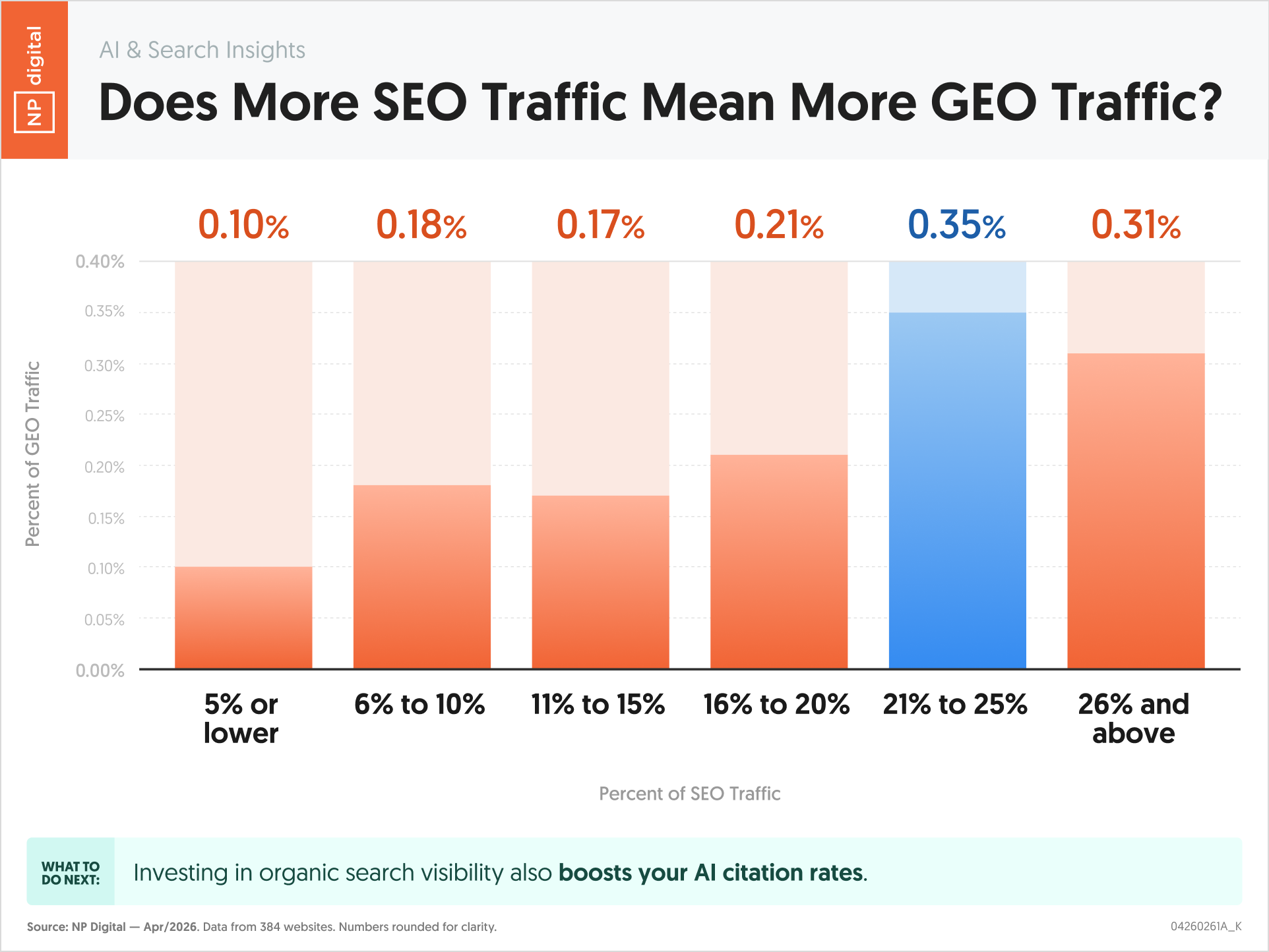
The intuitive assumption is that more SEO traffic means more GEO traffic. The data from 384 websites confirms the relationship is real but not linear. GEO traffic as a share of total sessions increases as SEO traffic share grows, but peaks at the 21 to 25 percent SEO cohort and then dips slightly for the highest-SEO cohort. Strong organic search performance helps AI citation rates, but at some point, additional SEO traffic alone does not continue to drive proportional GEO gains.
Essential Statistics
- Websites with five percent or lower SEO traffic share averaged 0.10 percent GEO traffic share, the lowest point in the dataset.
- GEO traffic share rose to 0.18 percent for the six to ten percent SEO cohort, then dipped slightly to 0.17 percent for the 11 to 15 percent cohort.
- The 16 to 20 percent SEO cohort showed 0.21 percent GEO traffic, resuming the upward trend.
- GEO traffic peaked at 0.35 percent for the 21 to 25 percent SEO cohort, the highest point in the dataset.
- The 26 percent and above SEO cohort showed a slight decline to 0.31 percent GEO traffic despite having the highest SEO traffic share.
- The overall range from lowest to highest GEO traffic share spans 0.10 percent to 0.35 percent, a 3.5 times difference between the weakest and strongest SEO cohorts.
Key Takeaways
- SEO traffic and GEO traffic are positively correlated, but the relationship is not linear and does not continue compounding at the highest SEO traffic levels. Brands in the 21 to 25 percent SEO traffic cohort extract the most GEO benefit from their organic visibility, while brands above 25 percent see marginal GEO gains taper.
- The dip at the highest SEO cohort suggests that very high organic traffic share alone does not guarantee proportional AI citation rates. Beyond a certain threshold of SEO performance, additional GEO optimization work, rather than more SEO, is likely what drives further citation share gains.
- The 3.5 times difference between the lowest and highest GEO traffic rates across cohorts confirms that organic search investment does produce meaningful AI citation gains, making SEO and GEO genuinely complementary rather than competing strategies.
- The slight non-linearity between the six to ten and 11 to 15 percent cohorts may reflect the composition of sites in each cohort rather than a true structural dip. Sites with moderate SEO traffic may have different content quality distributions than those at adjacent cohorts.
- The most actionable implication is for brands in the five percent or lower SEO cohort: at 0.10 percent GEO traffic share, their AI citation rates are the lowest in the dataset, and building organic search visibility is the single most correlated investment they can make to improve GEO outcomes.
Actionable Insights
- If your site is in the five percent or lower SEO traffic cohort, prioritize building organic search visibility before investing heavily in dedicated GEO tactics. The data shows the strongest correlation between SEO traffic share and GEO traffic share at the lower end of the range. Getting your organic foundation in place produces the highest relative GEO traffic gains per unit of SEO investment.
- If your site is already in the 21 to 25 percent SEO traffic cohort, the data suggests you are at or near the point where additional SEO investment produces diminishing GEO returns. Allocate incremental budget toward dedicated GEO optimization, structured content, schema markup, citation building, and AI platform-specific optimization rather than expecting more SEO traffic to continue driving proportional GEO gains.
- Use the 0.35 percent GEO traffic rate for the top-performing SEO cohort as a benchmark for your own site. Calculate your current SEO traffic share percentage and identify which cohort you fall in. Compare your actual GEO traffic share to the benchmark for your cohort. If you are below the benchmark, the gap may reflect a GEO optimization deficit that additional SEO investment will not close on its own.
- Present the positive correlation between SEO and GEO traffic to leadership as justification for continued organic search investment alongside AI optimization work. The data from 384 websites confirms that brands with stronger organic visibility extract more GEO traffic, providing external validation for budgets that fund both disciplines simultaneously rather than choosing between them.
- Monitor your GEO traffic share quarterly as your SEO traffic share changes. If increasing your organic search visibility does not produce corresponding GEO traffic gains at the rate the cohort data suggests, that is a signal to investigate whether your content structure, AI extractability, or citation eligibility are limiting your GEO performance independent of organic traffic volume.
“The relationship between SEO traffic and GEO traffic is real and positive, but it is not a straight line. Sites in the 21-to-25 percent SEO cohort get the most GEO traffic relative to their size. After that, additional SEO growth stops producing proportional GEO gains. That tells you where the compound leverage is and where you need dedicated GEO work instead of more organic traffic.” – Neil Patel