 Sign In








How Form Length Impacts Conversion Rate
Info
-
Source: NP Digital
-
Date: December 2024
-
Category: Ecomm & User Behavior
-
Study Methodology: Sample size: 404 landing pages with form-based conversions; Method: Analyzed form field counts and conversion rates on page-level visits; Notes: site-wide exit popups were excluded.
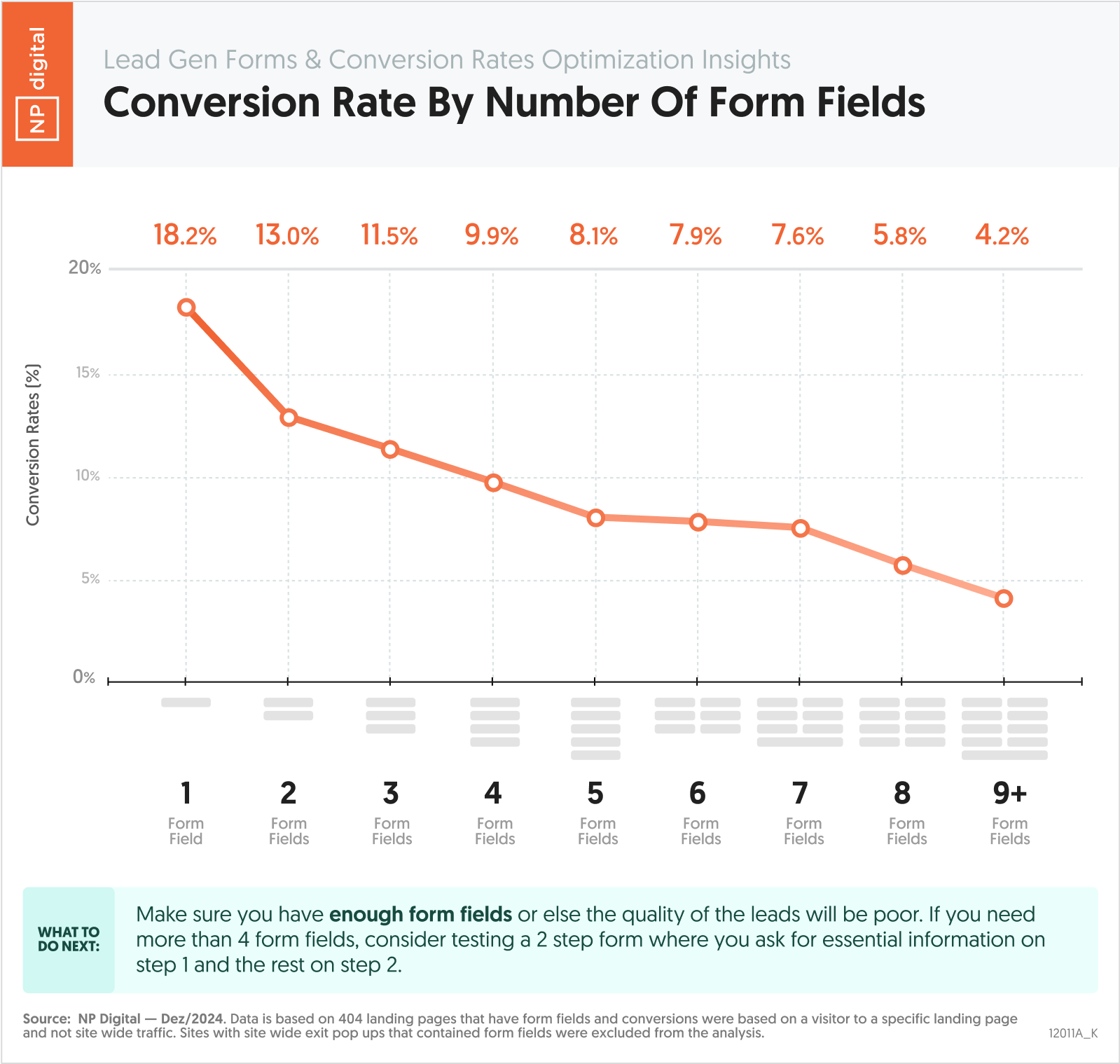
Form length decisions often get made by habit instead of data. This chart shows exactly how conversion rate declines as more fields are added to a form. It makes clear where friction starts to outweigh data capture. Use this insight to design forms that convert without sacrificing downstream quality.
Essential Statistics
- One-field forms convert at 18.2%, the highest rate observed in the dataset.
- Conversion drops to 13.0% with two fields and 11.5% with three fields.
- Four-field forms convert at 9.9%, falling below double-digit performance.
- Five-field forms convert at 8.1%, marking a sharp decline in submissions.
- Seven-field forms convert at 7.6%, showing diminishing returns from added data.
- Eight-field forms convert at 5.8%, while nine or more fields fall to 4.2%.
Key Takeaways
- Every additional form field introduces measurable conversion friction.
- The steepest conversion losses occur after the first two fields.
- Long forms dramatically reduce submission volume without guaranteeing better leads.
- Form length should be dictated by funnel stage, not internal data preferences.
- Shorter forms maximize lead flow, while longer forms require stronger intent signals.
- Progressive profiling is essential when deeper qualification is needed.
Actionable Insights
- Use one to two fields for top-of-funnel offers, because conversion stays above 13% and maximizes lead volume. Capture only name and email initially, then qualify leads later through behavioral data and follow-up interactions.
- Limit core lead gen forms to three or four fields, because conversion drops below 10% beyond that point. Reserve additional questions only for fields that directly affect routing, pricing, or sales qualification.
- Avoid single-step forms with five or more fields, because conversion falls sharply to 8.1% or lower. If more data is required, split the experience into multiple steps to preserve momentum.
- Match form length to intent level, because high-intent pages can tolerate more friction. Use shorter forms on paid and content-driven pages, and longer forms only on demos, pricing, or account requests.
- Continuously test field necessity, because many fields persist without driving outcomes. Remove any field that does not change scoring, segmentation, or sales action to reclaim lost conversions.
- Pair shorter forms with enrichment tools, because data quality does not have to come from the form itself. Use enrichment post-submit to fill gaps without asking the user to do extra work.
Shorter forms win on volume every time. If you need more data, earn it after the click, not before. – Neil Patel