 Sign In








The year is quickly drawing to a close. And everyone wants to start talking about what the hot new marketing trends will be next year.
You know what I bet will be on everyone’s lists? Mobile marketing.
But “mobile” as a marketing trend is too broad.
There’s so much that you can do with mobile marketing to drive leads and sales to your business. It deserves more than a brief shout-out.
This game-changing force deserves its fanfare.
In Mary Meeker’s Internet Trends 2017 report, she says that people spend 3.1 hours of every day on their mobile devices.
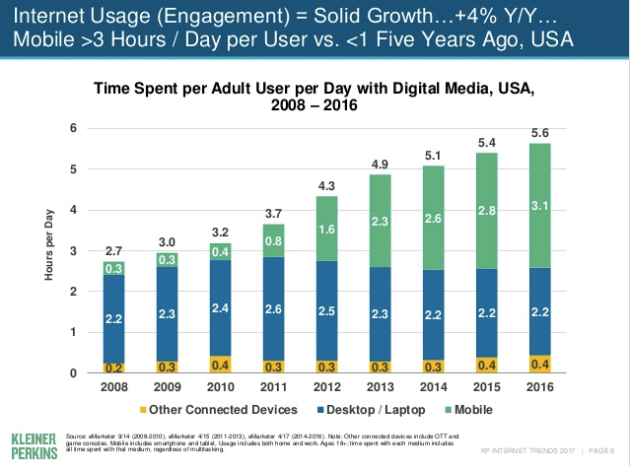
That is a huge opportunity to meet your audience.
But mobile marketing isn’t as simple as “run an ad here” or “make your design responsive.”
That said, it’s a great way to start generating passive income for your site.
If you want to stay ahead of the curve, then you need to master mobile marketing trends. Here are six you should embrace (and two you should flat-out ignore).
Six mobile marketing trends you should embrace
Remember when mobile SEO was a major topic of discussion thanks to Google’s Mobilegeddon? Responsive design and page speed optimization are both a given now.
What we need to focus on are the actions you can take to improve your awareness and reputation with mobile users. So, how do you do this? Let’s start with advertising.
Trend #1. Advertising
Mary Meeker’s report is something I look forward to every year.
With just a few hundred slides to work with, her analysis of the previous year’s Internet trends can paint an accurate picture of things to come.
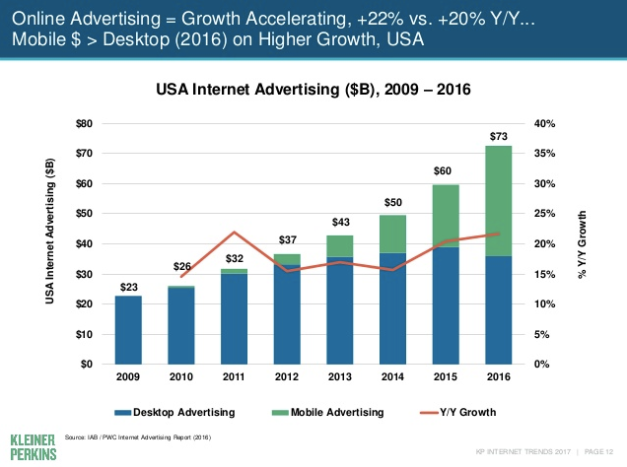
For example, here is a chart that depicts the massive growth of mobile advertising spend over the last year:
Now, here is what she had to say when showing where advertisers missed the mark in spending their ad dollars:
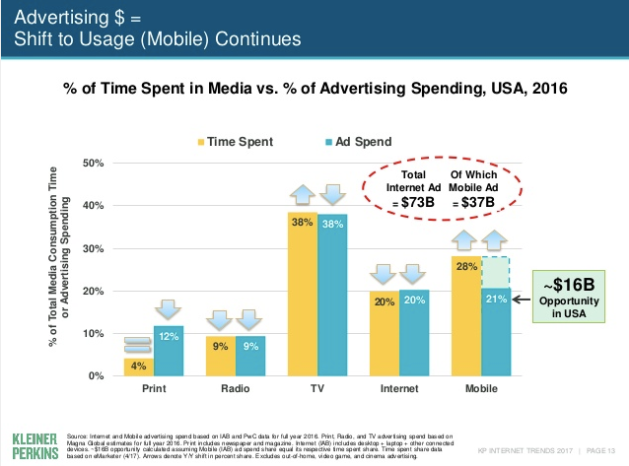
As you can see, ad spend was spot-on when it came to understanding customers’ exposure to radio, TV, and Internet.
But there is a big gap between what they spent for print and mobile, and what their consumers ended up doing with it.
In fact, this disparity led to $16 billion in missed opportunities on mobile.
However, advertising on mobile isn’t going to be that easy for marketers in the coming year.
With ad-blocking technology growing ever more present on mobile devices, there are more challenges now than ever.
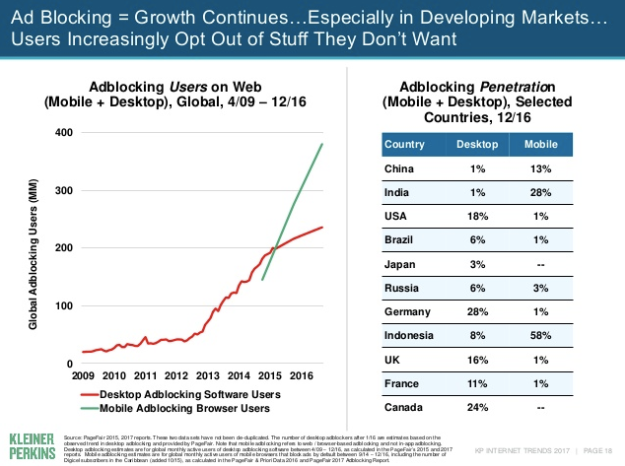
One way you could get around this?
Google Shopping is pay-per-click search marketing.
However, unlike PPC, it ensures your product shows up, even when your customer is blocking ads.
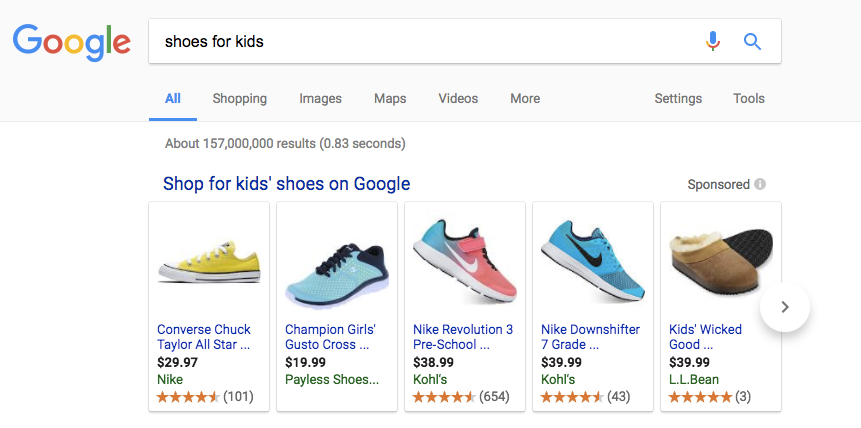
According to the Mary Meeker report, 52% of all paid clicks in search happen in these Google product listings.
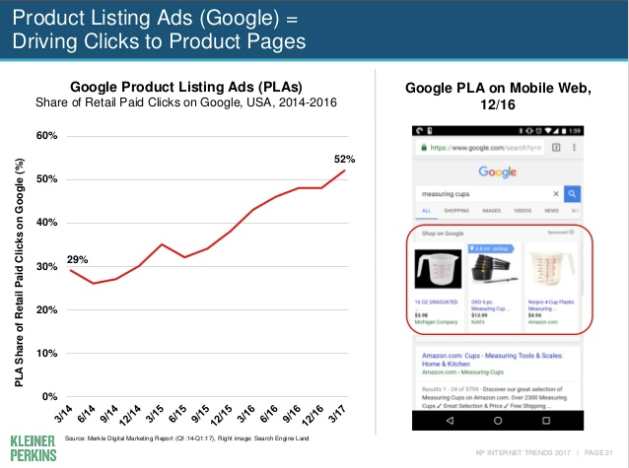
So, maybe you can’t reach your audience with banner ads, retargeting ads, or other paid marketing.
But, if you can get your products placed at the top of Google search results like in the example above, well then, you may have found a new way to use your advertising budget.
Trend #2. Apps
Should every business invest in a mobile app?
That question most often leads to divided results: some people believe you need a mobile app while others don’t.
And you know what? They’re both right.
Smartphone apps make sense for some businesses. Online news outlets, lifestyle and fashion bloggers, restaurants, productivity software, and health and fitness do really well in app form.
In PwC’s Total Retail Key Findings, they found that many people still prefer to use their mobile browser to engage with brands instead of through mobile apps.
But that doesn’t make them any less of a powerful tool when used by the right businesses.
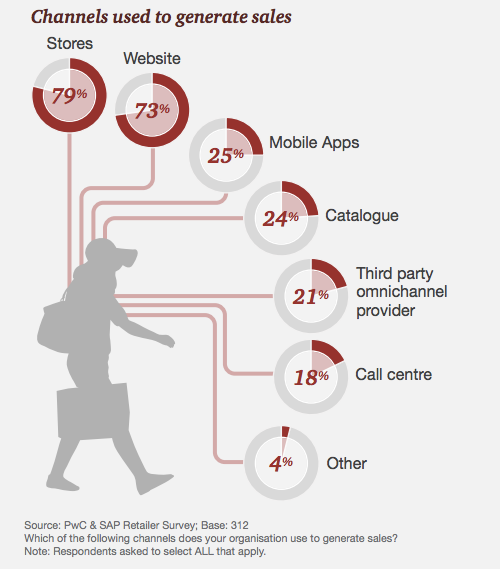
So, if you already have a mobile app or your consumer base is clamoring for one, and you’re ready to pull the trigger, I say go for it.
If you know the need is there, then this is a smart move.
ComScore’s Metrix report just announced that, for the first time, Americans now spend more than 50% of their online time with mobile apps.
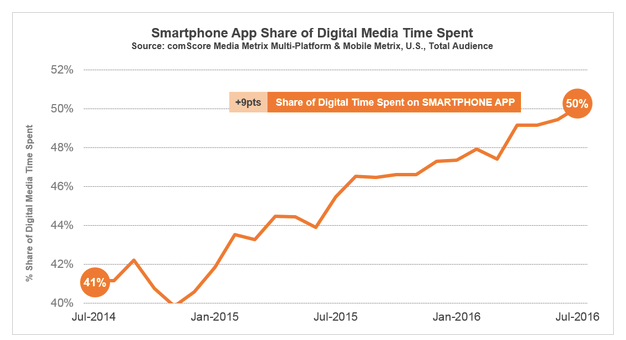
As a result, this is likely why Google has updated its algorithm to start showing smartphone apps — and not just apps, but the specific content within your apps — in search results.
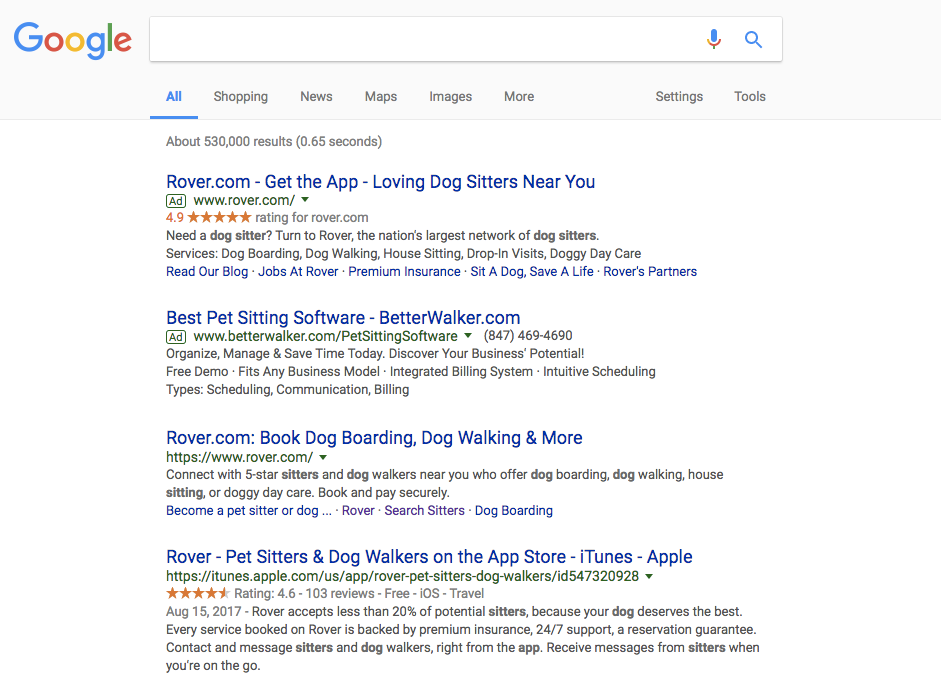
So, now, it’s not about hoping that users find you as they hunt through the Apple or Android stores for your app.
If optimized correctly, you’ll have the power of Google search on your side, helping new consumers find your app.
Trend #3. Gamification
Gamification is not a new marketing trend. We’ve been talking about this one for a while.
But the way gamification looks now and how businesses use it looks much different thanks to augmented (AR) and virtual reality (VR).
Take a look at how Lowe’s created a gamified augmented reality experience.
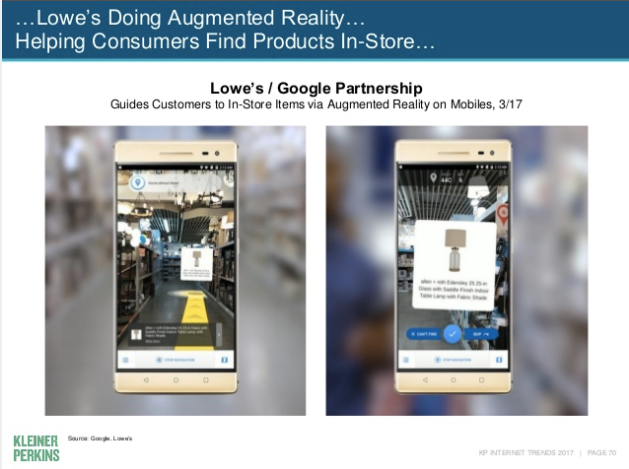
It makes sense why gamification works. It’s:
- Fun
- Convenient
- And gives shoppers the ability to speed up their checkout time
As for Lowe’s? They get:
- Greater customer loyalty
- Access to more customer data
- And appear cutting edge to their customers
Not bad, right?
Gamification may come more naturally to generations that have been gaming since birth.
Until Generation Z enters the workforce, that means I’m talking about Generation X and the Millennials:
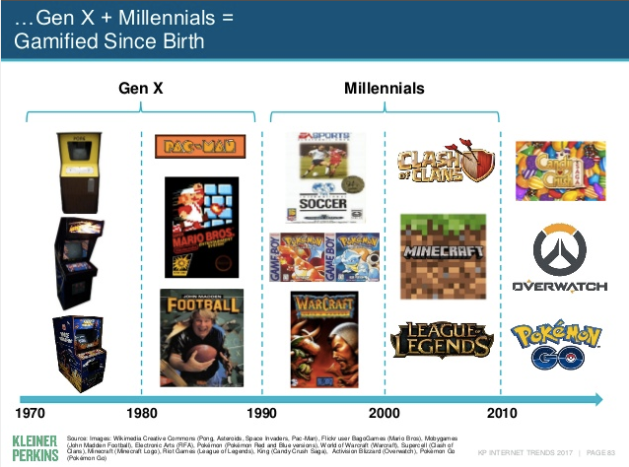
But, look, even if you’re not primarily serving Millennials and Gen X’ers, many people enjoy gamification.
Regardless of what type of business you run, there are ways to add your mobile presence with gamification elements.
You can use interactive puzzles, rewards, social competitions, and so on.
Later on, you can add in VR and AR to bring your gamification to life and increase your sales.
In a survey done by Walker Sands, they asked consumers what they thought about virtual reality. Here is how VR affected the respondents’ buying decisions:
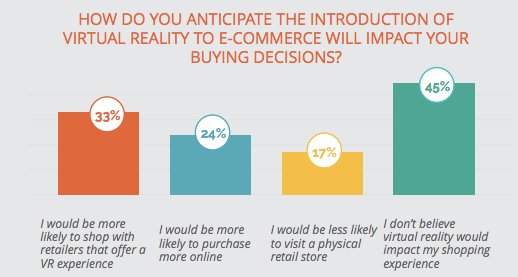
VR and AR are beginning to serve as a bridge between in-store and online shopping, much like what we saw in the Lowe’s example earlier.
Until customers decide that they prefer mobile shopping over in-store purchases, mobile gamification is an attractive way to market to tomorrow’s customers.
Trend #4. Search
The chances are good that you as a consumer have used your mobile device to search the web. Tell me: does the way you search on mobile differ from how you search on a desktop?
If you’re not already doing so, you should be asking that same question about your customers’ behavior.
And it’s one you’ll need to answer for your organization if you want to optimize the mobile search experience for your users.
Here are a couple of points to think about:
Would your site benefit from hyper-local search optimization?
We’ve already seen what specific search can do for you for Google Shopping’s product listings.
But what about giving your organic search a local hook?
According to Google, its users visit 1.5 billion locations every month based on something they came across in search results.
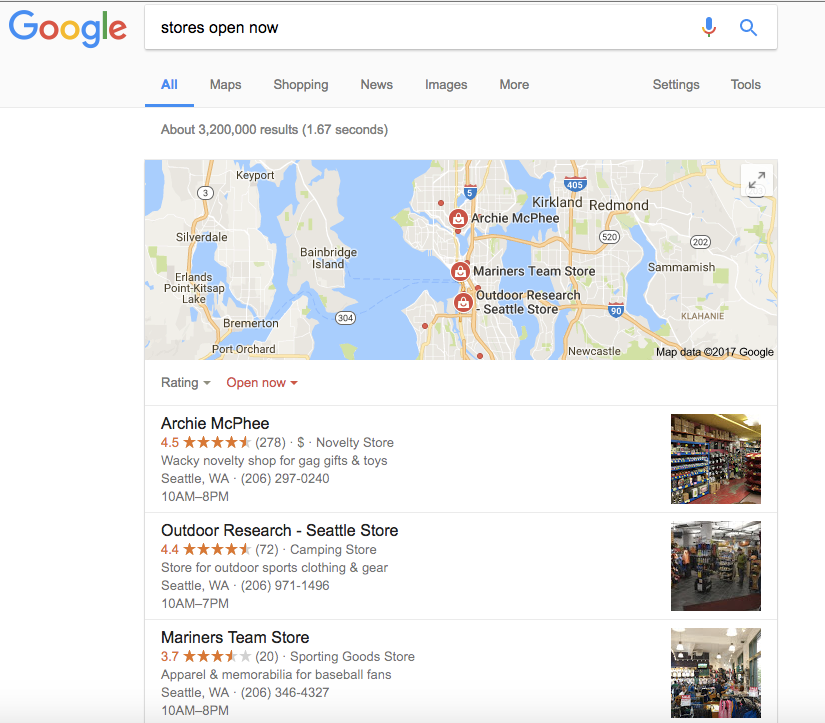
Their research also shows that:
- 30% of all searches on Google are location-based.
- The past year has seen a 2.1x increase in mobile searches for “stores open now.”
- There has also been a 1.3x increase in “where to buy/find/get” searches.”
In a search for “stores open now,” Google’s recommendations for related searches don’t stop with “stores”:
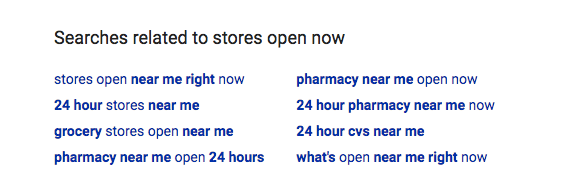
As you can see, there is a real sense of convenience and urgency in how many people now use mobile search.
With the multi-channel marketing strategy now becoming the now more and more, this shouldn’t be a surprise.
The bricks and online experiences need to work as one connected unit. And with mobile search, that can be the gateway between the two buying experiences.
If you aren’t sure whether or not hyper-local search marketing would be worthwhile, take a look at the rest of the Google survey results:
- 76% of people who searched for something nearby end up visiting the place.
- 28% of those mobile searches led to a purchase.
Local search isn’t the only way you’re going to see your users working with Google to find your website.
Which brings me to my second point:
Would your site benefit from voice search optimization?
It’s an interesting concept to consider, right?
You’ve got Amazon Echo and Google Home, which gives you voice-activated control over your home devices.
Then you’ve got Apple Siri to help you use your mobile device.
But what about voice-activated search?
Stone Temple research found that people conducted mobile searches through a variety of ways:
- 85.6% used their browser
- 74.2% used a search app
- 57.8% used voice search
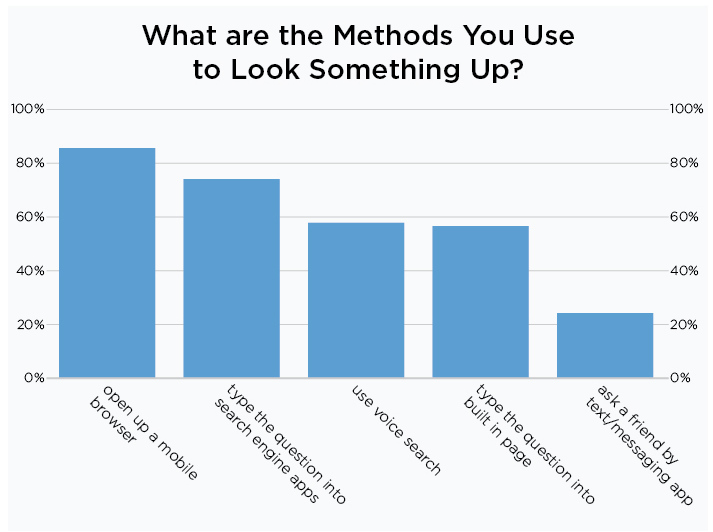
A little over half of those surveyed mentioned using voice search.
That’s pretty impressive considering Mary Meeker reported that 20% of mobile searches were initiated by voice.
Even if your users aren’t using voice search yet, that doesn’t mean this is a marketing trend you shouldn’t embrace.
Think about it this way:
Your mobile device is not like your desktop computer.
You engage with it in a way that’s different, perhaps a little more social and less formal.
So, when it comes time to search, you’re still in that same frame of mind.
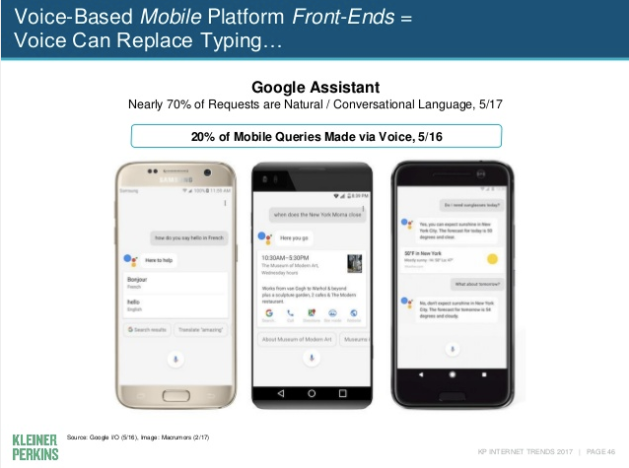
In fact, research from Google shows that 70% of requests made through Google Assistant are natural phrases instead of truncated search terms you’d never hear in spoken language.
So, what does this mean exactly? Well, two things.
For one, you don’t necessarily need to equip your site with voice-activated search functionality.
On the other hand, what you should do is optimize your site with long-tail keywords written in more natural, everyday speech.
Website content focused around formal search words won’t play very well with the new (vocalized) keywording trend.
Trend #5. Security
It would be great if every single mobile trend were positive.
A trend that gets us excited about trying something new and innovative to get more leads.
Alas, that’s not always the case because with new technology comes new security risks.
Business owners and marketers know this, and your customers are most definitely aware of it as well.
A PwC survey indicated that roughly two-thirds of consumers are too nervous to shop on their mobile phone.
Why? They are afraid of being hacked.
Mobile apps are no different as Walker Sands found that 61% of shoppers won’t use a mobile app due to security concerns.
And 58% won’t use an app out of a fear of compromised privacy.
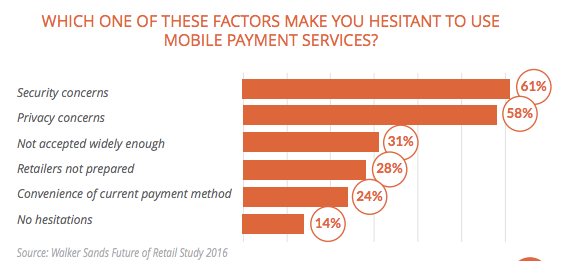
Customers are reluctant to shop from their mobile devices, that’s clear.
That’s why people like Madeleine Thomson of PwC suggest that businesses need rigorous security systems if they want to reach the mobile audience.
In other words, security needs to be a top priority.
Trend #6. Video
Last, but not least, there’s mobile video.
As I’ve said before, videos are an easy-to-digest form of content for your customers.
If you’ve already created high-quality and valuable video content for your site, then you understand what an incredible tool it is to have in your arsenal.
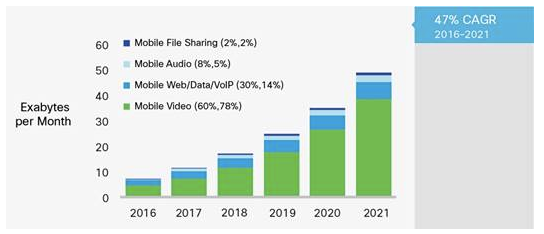
Research from Cisco further demonstrates the power of video, especially as it pertains to a mobile audience.
According to the forecast:
- In 2016, 60% of mobile traffic came from videos.
- By 2021, over 75% of mobile data traffic will come from videos.
Salesforce also recognizes the strengths of mobile video in the hands of B2B businesses.
Based on their research, they found that 91% of the B2B buyer’s journey takes place on a mobile device.
And Hubspot found that 75% of business execs watch work-related video content at least weekly.
So, you have the majority of the path-to-purchase occurring on mobile devices.
You then have three-quarters of business executives actively engaging with video content.
Put those together, and you have a killer marketing duo.
It’s no wonder 96% of B2B companies plan to use video in their content-marketing strategy over the next year.
Two mobile marketing trends you should throw away
Marketing trends come and go. That’s just the nature of the business.
And, as such, it means you need to be ready to adapt at a moment’s notice. (Especially if Google demands it.)
When it comes to marketing trends, I don’t like to think about any of them as worth “throwing away.” I just view them as trends that could use an upgrade.
And that’s what we have here.
Trend #1. Mobile-only
Paul Adams, the VP of Product at Intercom, makes a good point about mobile-first strategies:
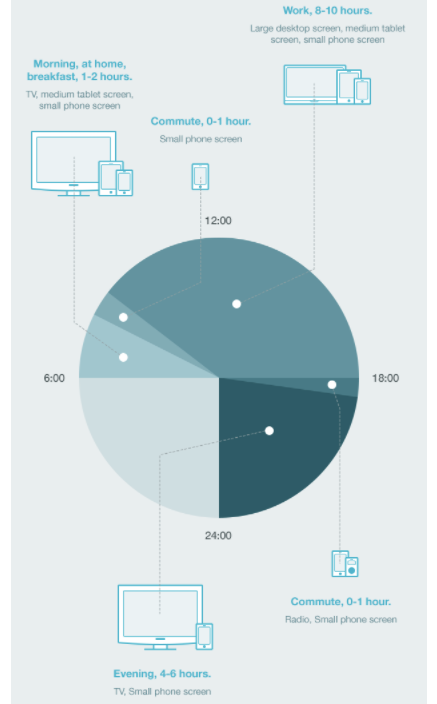
“It’s true that for many people their mobile screen is their primary screen most of the time. What’s not true is that this is the only screen that matters.”
With the revelation that the smartphone had become a leading marketing sales channel, mobile-first marketing strategies made sense a few years ago.
But that’s all changed now. We already know how important mobile devices are in the grand scheme of what we do.
What we have lost sight of is that there are still other devices in play.
That’s why we need to cool it with the mobile-first marketing trend.
Obviously, mobile will continue to be a priority in digital-marketing strategies. That’s why we’re having this discussion in the first place.
Google even announced in late 2016 that it would soon update its algorithms in favor of a mobile-first approach.
All they’re trying to do there is give priority to responsive-designed websites.

Those points go to show that you can’t really remove the mobile experience from the desktop (or even the mobile app). They all need to be part of a greater whole.
The solution then is to move toward a multi-channel marketing strategy that not only takes into account the individual strengths of each platform but also connects them.
Trend #2. Beacons
Beacons and geofencing had some major buzz when the technologies first made an appearance around 2014.
American Express called beacons “the next big thing.”
Wired pointed out all the ways this tech could be valuable but questioned if it would ever catch on.
In theory, they are a fantastic way to market to the mobile consumer.
The numbers tell a different story though.
According to Walker Sands, only 6% of customers have enabled beacons to communicate with them through mobile devices.
For those who’ve chosen not to opt in, their reasoning will sound familiar at this point:
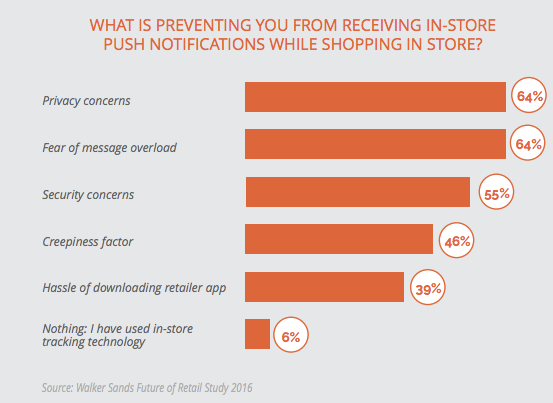
Then there’s the fact that beacons require users to download an app for each brand that uses beacon technology.
Push notifications are a great way to get front-and-center with customers.
But if you don’t already have their attention and loyalty, how do you motivate them to download an app?
Well, it’s funny you should ask because Walker Sands looked into that as well.
They found that customers would be willing to give their favorite brands the ability to track them and send push notifications for greater convenience and more perks. More specifically:
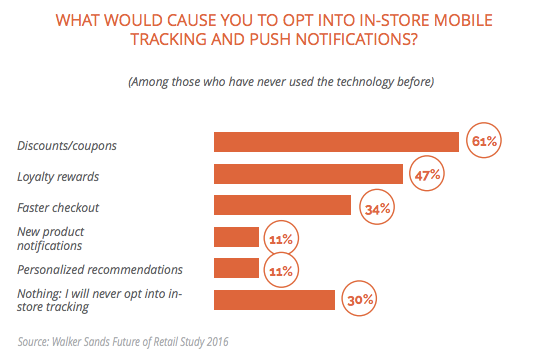
So, hyperlocal search marketing is in. Hyperlocal geofencing and beacon technology? Not so much.
But, as you can see, there are ways to make this outdated marketing trend work.
Conclusion
Smartphones have changed the marketing game.
But as quickly as smartphone technology changes, so too does our mobile-marketing strategy.
As you can see, the mobile-marketing trends worth embracing put a focus on improving the convenience of finding and engaging with brands through a mobile device.
They also move away from some of the previous methods consumers found annoying and invasive.
If there’s one main thing to take away from all this, it’s this:
Mobile is just a marketing channel.
What we’re talking about here is serving our customer.
If they want us to reach them on mobile, that’s where we’ll go.
If they want to use mobile devices differently, then we must make that accommodation.
And if their behaviors on mobile change, then we must adapt right alongside them.
What mobile trends are you embracing with success?