 Sign In




AI Visibility Readiness Assessment: Where Brands Stand
Info
-
Source: NP Digital
-
Date: May 2026
-
Category: AI & GEO Optimization
-
Study Methodology: Sample size: 500 marketers and business owners. Collection method: Online survey. Scale: 1 (lowest maturity) to 5 (highest maturity).
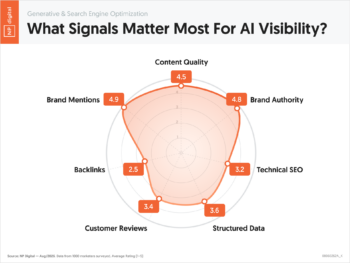
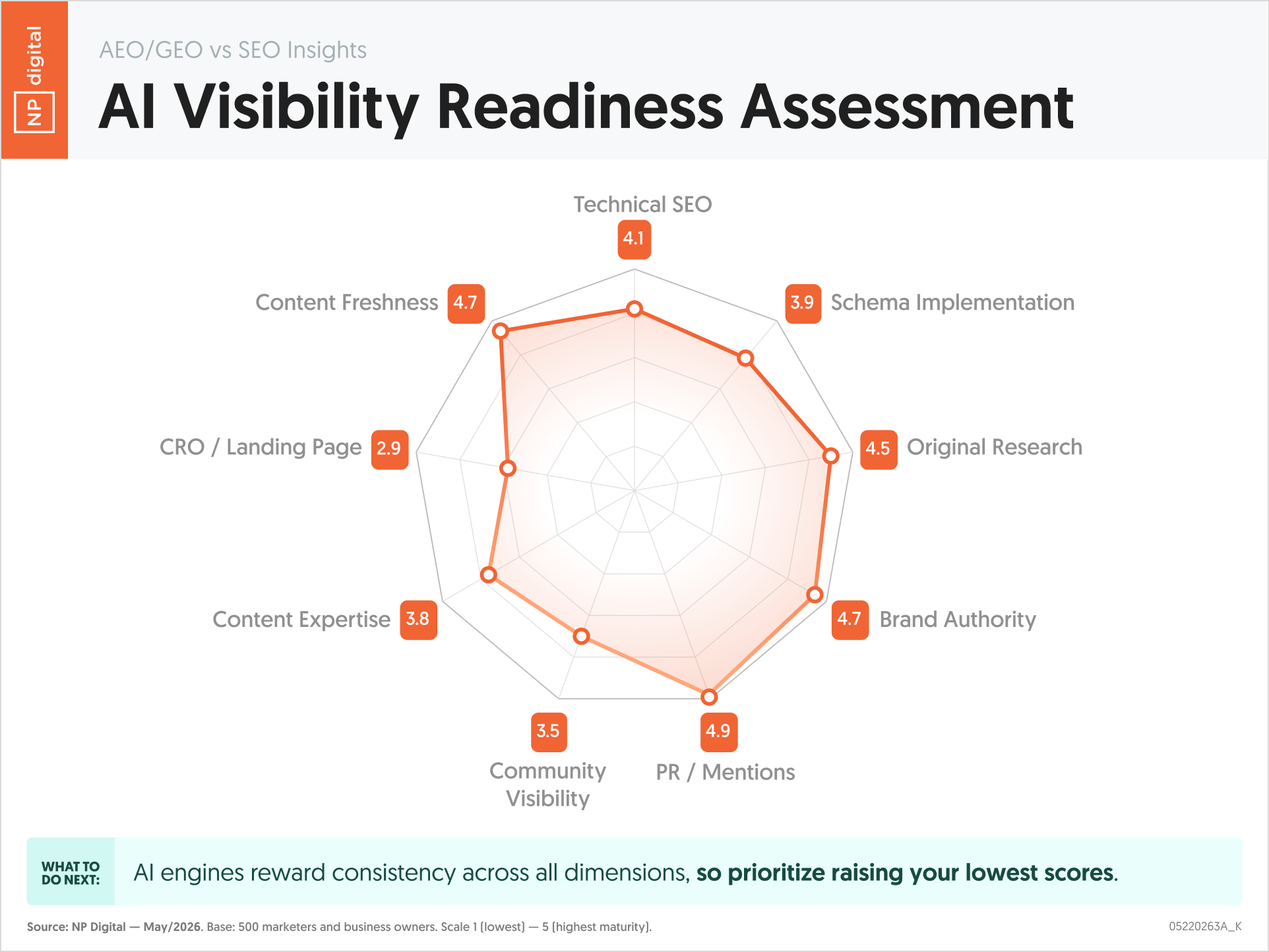
AI visibility readiness is not a single score. It’s a profile across nine dimensions, and the shape of that profile matters as much as any individual score. This radar chart, based on 500 marketers and business owners rating their maturity on a 1 to 5 scale, reveals a consistent pattern: brands are strongest in the reputation and content dimensions that drive citation selection, and weakest in the conversion infrastructure and community dimensions that determine what happens after a citation occurs. The implication is that many brands are investing in earning AI citations without adequately investing in what those citations are supposed to produce.
Essential Statistics
- PR and Mentions score the highest AI visibility readiness rating at 4.9 out of 5.
- Brand Authority and Content Freshness both score 4.7, tied for second place.
- Original Research scores 4.5 maturity, ranking fourth.
- Technical SEO scores 4.1, ranking fifth.
- Schema Implementation scores 3.9 and Content Expertise scores 3.8, ranking sixth and seventh.
- Community Visibility scores 3.5, ranking eighth.
- CRO and Landing Page optimization scores the lowest at 2.9 out of 5, the only dimension below 3.0.
Key Takeaways
- The high scores for PR and Mentions (4.9), Brand Authority (4.7), and Content Freshness (4.7) reflect deliberate investment in the reputation signals that the AI visibility factors chart shows are most important. These brands have built the citation-earning infrastructure and are appearing in AI answers. The question raised by the lower scores in other dimensions is whether the citations are producing the business outcomes they are supposed to generate.
- CRO and Landing Page at 2.9 is the most expensive gap in the readiness profile. A brand earning strong AI citations for its category is driving discovery traffic to its digital properties. If the landing page experience fails to convert that traffic, the citation value is wasted at the last mile. The highest-scored dimensions create the opportunity; the lowest-scored dimension determines whether that opportunity converts to revenue.
- Schema Implementation at 3.9 is below the strong reputation scores but represents one of the most accessible improvement opportunities in the dataset. Unlike PR coverage or brand authority, which require sustained investment over time, schema markup is a technical implementation project with a defined scope. A comprehensive schema audit covering Organization, Article, FAQ, Product, and Review markup can be completed in weeks and directly improves how AI engines understand and categorize a brand’s content.
- Community Visibility at 3.5 is the dimension most misaligned with the discovery data showing Reddit, forums, and community platforms at 10 percent of brand discovery combined. Strong PR and brand authority scores indicate investment in top-tier publication coverage, but community platforms where peer-to-peer discussion happens are a distinct channel with distinct content expectations. The gap between 4.9 in PR and 3.5 in Community Visibility suggests that community building is being deprioritized relative to its contribution to discovery and AI citability.
- The overall readiness profile shows a brand ecosystem well-prepared to earn AI citations but less prepared to capitalize on them. The investment pattern reflects a strategy that has optimized for the top of the AI visibility funnel without fully building out what happens below it.
Actionable Insights
- Score your own organization against these nine dimensions using the same 1 to 5 scale before making any AI visibility investment decisions, and treat your two lowest-scoring dimensions as the priority areas for the next planning cycle. Most organizations will find their scores cluster similarly to the benchmark. Specific gaps will differ by industry and business model. Know your specific profile before investing against generic benchmarks.
- Address CRO and Landing Page at 2.9 as the first AI visibility investment that does not involve creating more content or building more citations. If your brand is earning AI citations for category keywords, the cited pages need to convert the traffic those citations generate. Audit the landing pages most likely to receive AI-citation traffic against a basic conversion checklist: page load time under three seconds, clear value proposition in the first viewport, friction-minimized primary CTA, mobile-optimized layout, and social proof visible above the fold. Any page failing more than two of these criteria is costing you revenue from citations you have already earned.
- Implement a comprehensive schema markup strategy covering the five most impactful types for AI visibility: Organization schema on your homepage, Article schema on your content pages, FAQ schema on your question-and-answer content, Product schema on your product or service pages, and Review schema where you have review content. At 3.9, schema implementation is close to the stronger reputation dimensions but still has room to improve. Use Google’s Rich Results Test to surface which pages are missing markup and which have implementation errors.
- Build a community visibility program targeting the platforms where your audience conducts peer research and recommendation. At 3.5, Community Visibility is the second-lowest score in the benchmark. Identify the two or three community platforms most active in your category and assign a team member to contribute expert-level content consistently for 90 days before evaluating the impact on brand mentions and citation signals.
- Treat the alignment between your highest-scored and lowest-scored dimensions as a conversion funnel problem. The readiness profile shows a funnel where the top is well-built, but the bottom needs investment. The next phase of AI visibility investment for brands scoring similarly to this benchmark should prioritize conversion and community dimensions rather than adding further investment to already-strong citation-earning dimensions.
“The lowest score on this chart is CRO at 2.9. That is the most expensive gap in the profile because it is where citation value gets wasted. You can earn all the AI citations in the world, but if the page experience fails, the citation does not produce a business outcome. Fix the floor before you keep building higher.” – Neil Patel