 Sign In







Personalization Vs Conversion Trade-Off In Forms
Info
-
Source: NP Digital
-
Date: November 2024
-
Category: Ecomm & User Behavior
-
Study Methodology: Sample size: 833 top-of-funnel landing pages across industries; Method: Analyzed conversion rates relative to number of form fields over 12 months.
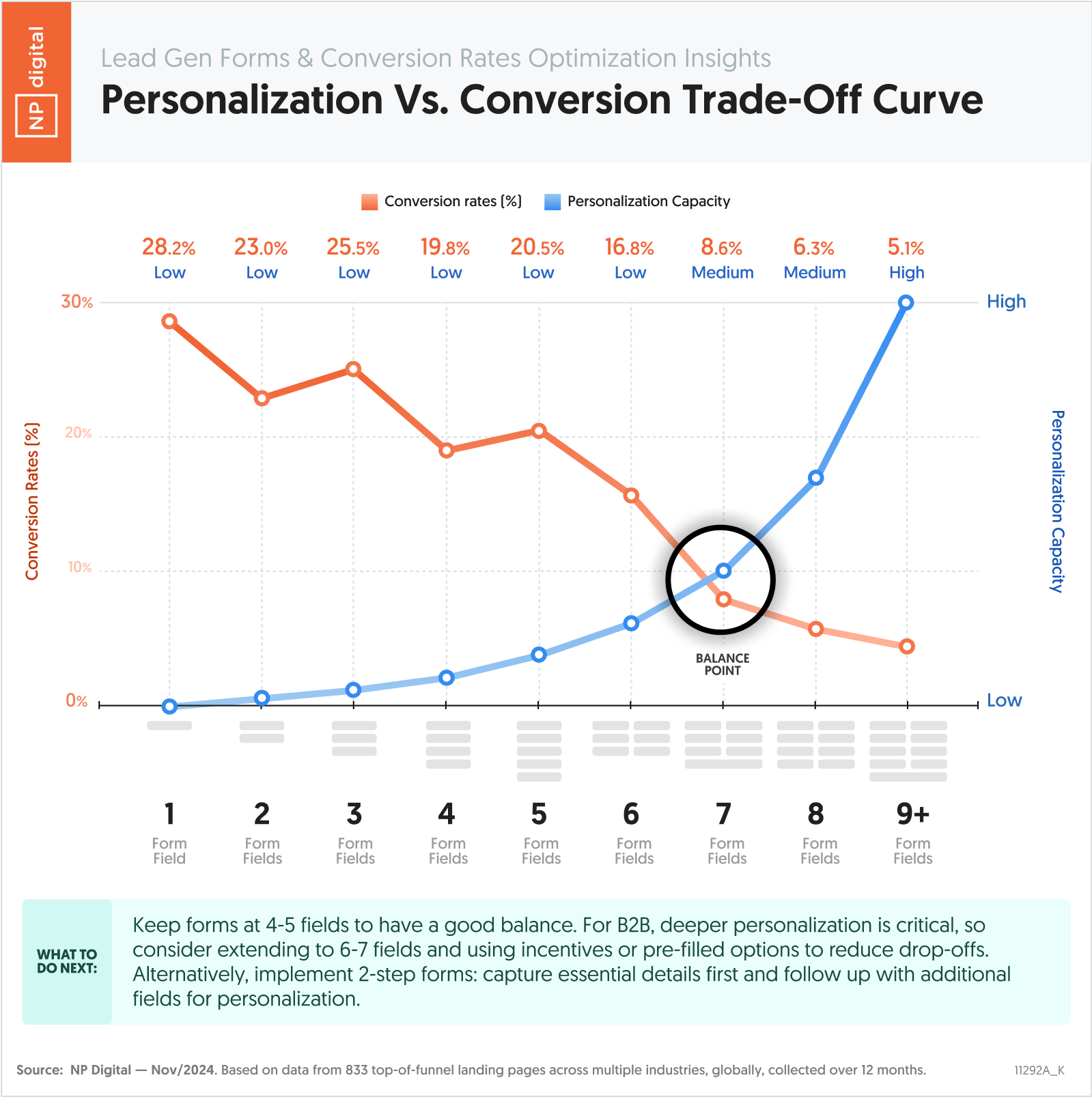
Marketers often assume more data always leads to better outcomes. This chart shows the real trade-off between personalization capacity and conversion rate as form fields increase. It highlights a clear inflection point where added friction starts hurting results. Understanding this balance is critical for designing forms that convert without sacrificing lead quality.
Essential Statistics
- Forms with 1 field convert at 28.2% but provide minimal personalization capability.
- Conversion rates decline steadily as fields increase, dropping to 20.5% at 5 fields.
- The balance point occurs at 7 fields, where conversion falls to 8.6% while personalization reaches medium levels.
- Forms with 9 or more fields convert at just 5.1% despite offering high personalization capacity.
- Adding fields beyond 7 produces diminishing returns in data quality relative to conversion loss.
Key Takeaways
- Higher personalization comes at a measurable conversion cost, not a linear trade-off.
- The optimal balance for most marketers sits between 4 and 6 form fields, before steep drop-off begins.
- More data does not automatically mean better leads if fewer people convert in the first place.
- Form strategy should align with funnel stage, not default to maximum data capture.
- Two-step or progressive forms can help resolve the tension between conversion and personalization.
Actionable Insights
- Cap primary lead gen forms at 4 to 5 fields, because conversion remains above 20% while still enabling basic personalization. Prioritize fields that directly affect qualification and routing, and remove any that do not change downstream action.
- Use 6 to 7 fields only when personalization materially affects revenue, because conversion drops sharply to 8.6% at this level. Justify each additional field with a clear sales or lifecycle use case before adding friction.
- Avoid single-step forms with 8 or more fields, because conversion falls to nearly 5% while gains in personalization plateau. If that level of data is required, split the experience across multiple steps or post-conversion enrichment.
- Implement two-step forms to protect conversion, because they allow you to capture intent first and context later. Ask for name and email upfront, then progressively request additional details once momentum is established.
- Match form length to traffic intent, because high-intent visitors tolerate more friction than cold traffic. Use shorter forms for paid and top-of-funnel sources, and reserve longer forms for demos, pricing, or returning users.
- Audit form fields quarterly, because personalization needs change over time. Remove fields that no longer influence segmentation, scoring, or sales action to reclaim lost conversion rate.
The mistake is thinking more fields equal better leads. This curve shows you need just enough data to act, then earn the right to ask for more later. – Neil Patel