 Sign In





 Ubersuggest
  AnswerThePublic
 ChatGPT Search Sources: Google vs Bing
Info
-
Source: NP Digital
-
Date: July 2025
-
Category: AI & GEO Optimization
-
Study Methodology: Analysis of 800 web-enabled ChatGPT responses. Source URLs were categorized by originating search engine.
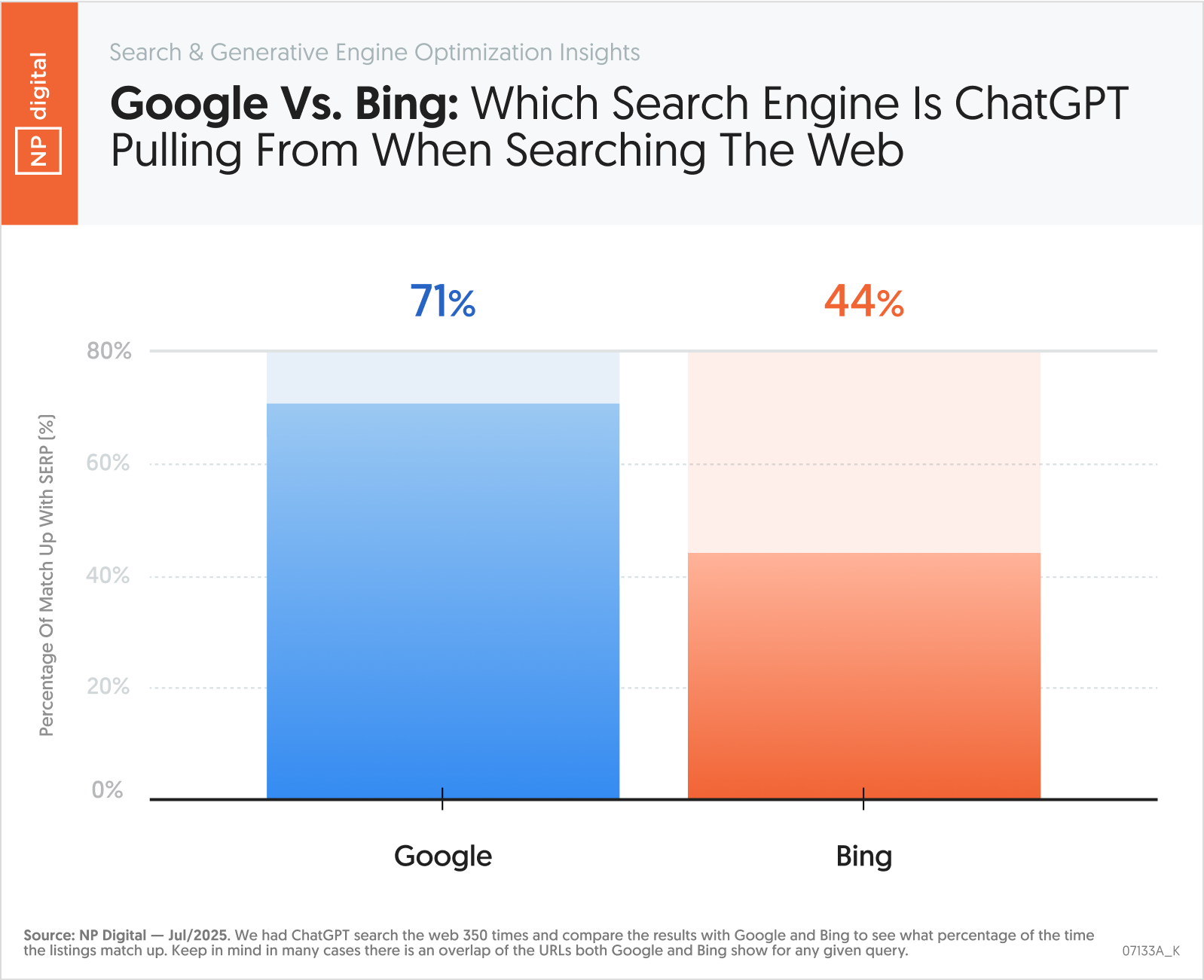
There is still confusion around where ChatGPT pulls its search results from. This data clarifies the split between Google- and Bing-powered sources. The takeaway is simple: visibility across both engines still matters.
Essential Statistics
- Google-powered sources accounted for over 55% of ChatGPT citations.
- Bing-powered sources represented roughly 45% of results.
- Brand queries skewed more heavily toward Google sources.
- Informational queries showed a more balanced split.
- Search source dominance varied by query type.
Key Takeaways
- Google continues to heavily influence ChatGPT responses.
- Bing remains a critical secondary source.
- Optimizing for one engine limits AI visibility.
- Query intent affects source selection. Multi-engine SEO is still required.
Actionable Insights
- Maintain strong Google SEO fundamentals because Google-powered sources still dominate many AI responses.
- Visibility in Google often translates directly into ChatGPT citations. Continue optimizing for Bing, as it still accounts for a large share of AI search sourcing.
- Ignoring Bing reduces total generative exposure. Strengthen brand entity signals across both engines to improve citation confidence.
- Consistent brand mentions help AI systems resolve authority. Monitor which engine surfaces your content most often by running real queries in ChatGPT.
- Use those patterns to prioritize optimization efforts. Build redundancy across search engines so shifts in AI partnerships do not erase visibility overnight.
ChatGPT does not favor engines. It favors confidence signals built through search. — Neil Patel